
Unlocking the Sun
The Accelerating Race Toward Commercial Nuclear Fusion Electricity Generation

Published 26-may-2026

Nuclear fusion has long promised clean, abundant energy by replicating the process that powers the sun, fusing light atoms to release vast amounts of power with minimal waste and no long-lived radioactive byproducts like those from fission. For decades, the technology remained confined to research laboratories and large government projects, with commercial viability seeming perpetually distant. Yet as of mid-2026, private companies and supportive governments have poured billions into development, driven by urgent global pressures. Rising electricity demand from artificial intelligence data centers, electric vehicles, and electrification of industries has strained grids and highlighted the limits of intermittent renewables and traditional nuclear fission.
Climate goals demand rapid decarbonization, while energy security concerns push nations to seek sources independent of fossil fuel geopolitics. Breakthroughs in materials science, particularly high-temperature superconductors that enable compact, high-field magnets, have slashed projected reactor sizes and costs, making private investment viable. Corporate power purchase agreements from tech giants signal market readiness, and policy frameworks in the United States, United Kingdom, and elsewhere are adapting regulations to accelerate deployment rather than treating fusion like fission. These converging forces have transformed fusion from a scientific pursuit into a competitive commercial race, with over 50 startups worldwide and private funding exceeding $9 billion.
Historical Development and the Shift to Commercial Trajectories
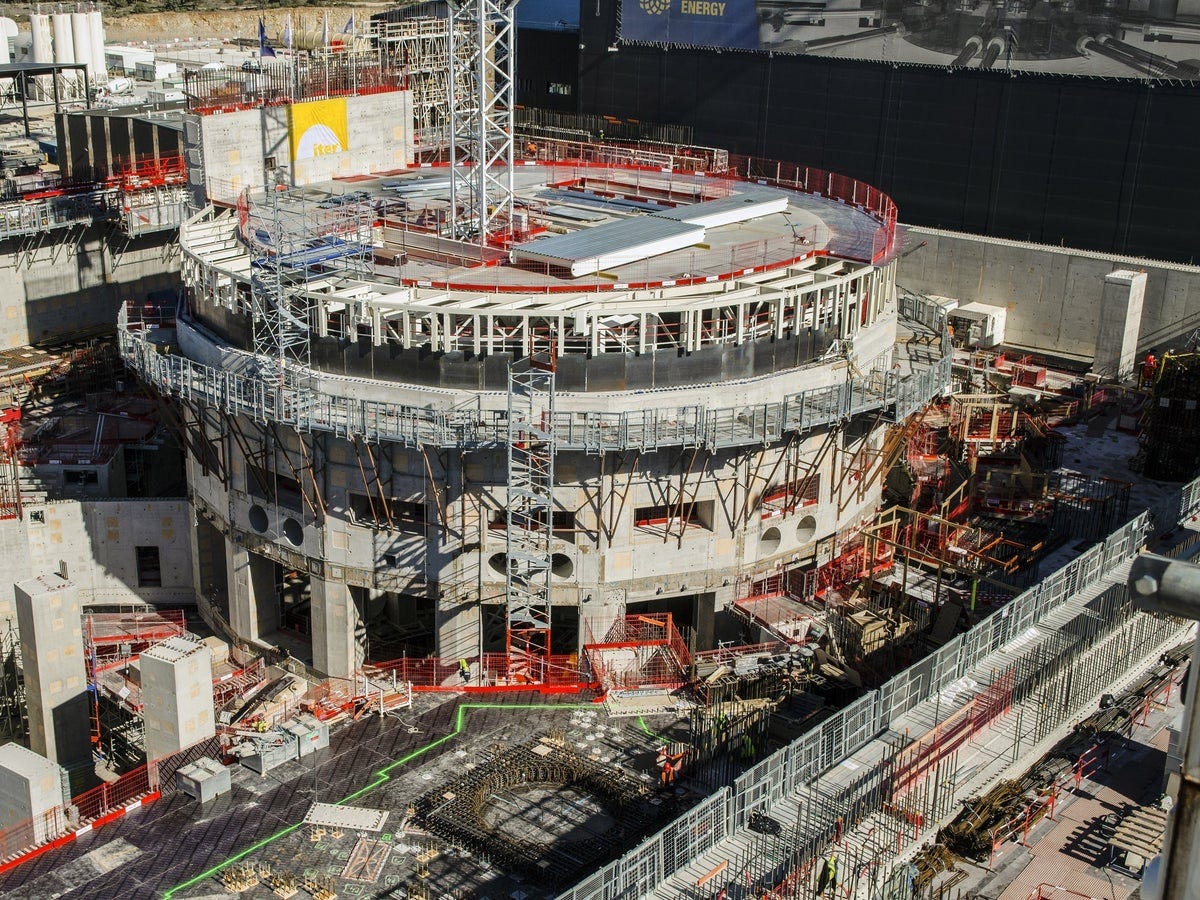
Fusion research traces back to the 1950s with early tokamak concepts from Soviet scientists and stellarator designs from the United States. Government-led efforts dominated for decades, achieving incremental gains in plasma temperature, density, and confinement time. The Joint European Torus (JET) set records in the 1990s and again in 2021 with 59 megajoules of fusion energy, while the National Ignition Facility in the United States achieved scientific breakeven in 2022 with inertial confinement using lasers. International collaboration produced ITER, the massive tokamak under construction in France, intended as a bridge to demonstration power plants. Yet delays and cost overruns have slowed progress. The real acceleration began in the 2010s and intensified in the 2020s as private capital entered the field. High-temperature superconducting (HTS) magnets, developed initially at MIT, allowed companies to pursue smaller, more affordable systems. By 2026, private firms have raised nearly $10 billion cumulatively, shifting the landscape from slow, publicly funded megaprojects to agile, milestone-driven development. This evolution reflects broader trends in energy innovation, where venture funding and corporate demand compress timelines that once spanned generations.
Main Actors, Tendencies, and Global Landscape
The fusion ecosystem now blends large international projects with nimble startups and national programs. ITER, involving 35 countries, remains the cornerstone of public research, though its timeline has slipped: full scientific operations are now slated for 2034, with deuterium-tritium reactions in 2039, reflecting engineering complexities in assembly and component integration. China leads aggressive national efforts with its own tokamaks and plans for a demonstration reactor in the early 2030s, supported by state funding around $1.5 billion annually. The United States benefits from Department of Energy roadmaps targeting pilot plants in the mid-2030s, while the United Kingdom advances through public-private partnerships and regulatory streamlining. Private companies dominate headlines and funding. Commonwealth Fusion Systems (CFS), spun out from MIT, has raised nearly $3 billion and leads in high-field tokamak development. Helion Energy, backed by over $1 billion including from OpenAI’s Sam Altman, pursues pulsed magneto-inertial fusion with direct electricity conversion. TAE Technologies, with $1.3 billion raised and a recent merger with Trump Media and Technology Group, focuses on field-reversed configuration (FRC) plasmas and aneutronic fuels for cleaner operation. Other notable players include Tokamak Energy (spherical tokamaks), General Fusion (magnetized target fusion with piston compression), Type One Energy (stellarators), and Zap Energy (shear-stabilized Z-pinch). Tendencies favor compact designs that reduce capital costs, diverse confinement methods to hedge risks, and public-private synergies, such as CFS applying to join the PJM grid operator or Helion’s partnerships with utilities. Geographically, the United States hosts the majority of startups, but Europe and Asia contribute specialized expertise in magnets and materials.
Current Technologies in Play
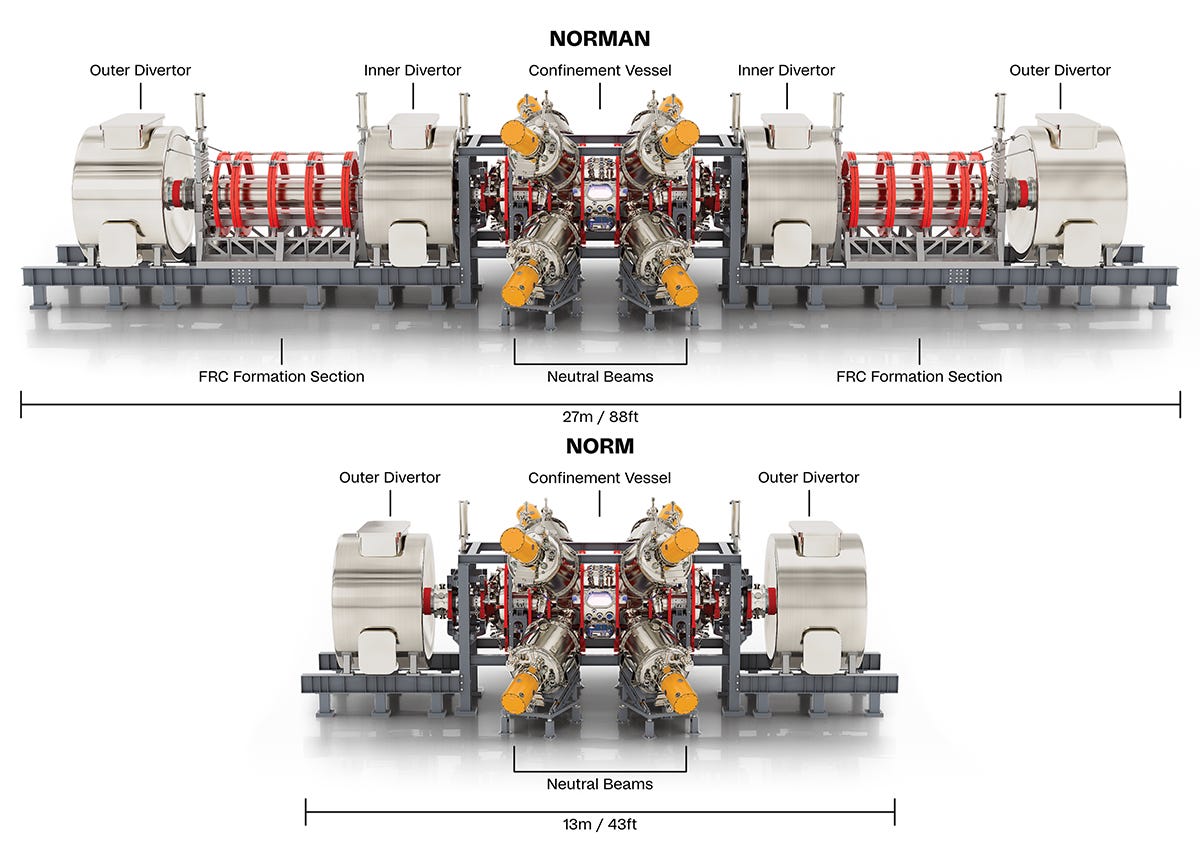
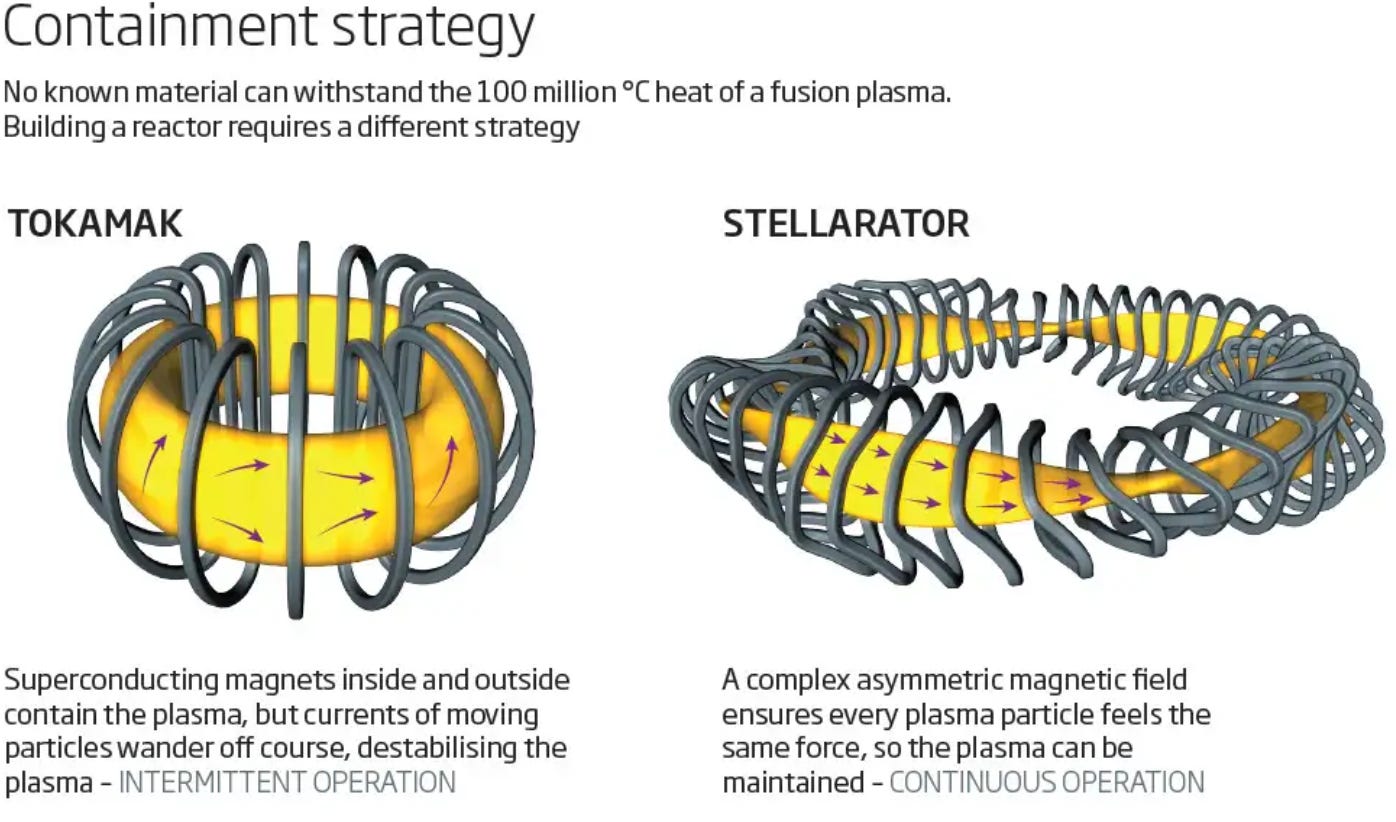
Fusion approaches fall into broad categories, each with distinct engineering paths to net electricity. Magnetic confinement dominates, using powerful magnets to contain superheated plasma. Tokamaks, toroidal devices with strong toroidal and poloidal fields, power most efforts; CFS’s SPARC prototype employs HTS magnets to achieve fields over 20 tesla, enabling net energy gain in a device far smaller than ITER. Spherical tokamaks, like those from Tokamak Energy, offer even more compact geometry. Stellarators use twisted, non-axisymmetric coils for inherently stable plasmas without plasma current, as pursued by Type One Energy and Proxima Fusion; Wendelstein 7-X in Germany has demonstrated long-pulse operation. Inertial confinement compresses fuel pellets with lasers or other drivers; while the National Ignition Facility proved the principle, commercial variants from companies like Xcimer and Focused Energy aim for high-repetition-rate systems. Magneto-inertial fusion hybrids, such as Helion’s pulsed FRC approach or General Fusion’s liquid-metal compression, combine elements for potentially simpler engineering. TAE’s FRC devices target advanced fuels like proton-boron-11, avoiding tritium handling. Across these, common elements include plasma heating to over 100 million degrees Celsius, sustained confinement, and energy extraction via heat or direct conversion. Progress in 2026 includes Helion’s Polaris achieving deuterium-tritium fusion at extreme temperatures and CFS advancing SPARC assembly toward first plasma in late 2026 or early 2027.
Persistent Problems and Technical Challenges
Despite momentum, fusion faces formidable hurdles before widespread electricity generation. Achieving and sustaining conditions for net energy gain requires precise control of plasma instabilities, where even minor disruptions can quench reactions. Neutron bombardment from deuterium-tritium reactions damages reactor materials, creating embrittlement, swelling, and activation that demand advanced alloys and frequent component replacement, potentially limiting plant availability to uneconomic levels. Tritium fuel supply poses another bottleneck; global stocks are tiny, and breeding blankets using lithium must achieve a ratio greater than one while multiplying neutrons with beryllium or lead. Heat exhaust through divertors must handle extreme fluxes without melting, and overall system efficiency must convert fusion heat or particles into grid electricity at competitive costs. Economic viability remains uncertain, with early plant estimates ranging widely due to customization and scale-up risks. Regulatory frameworks, still evolving from fission precedents, add uncertainty around licensing and safety demonstrations. Supply chains for magnets, cryogenics, and precision components must scale rapidly. These challenges compound in real-world operation, where reliability over years, not seconds, determines success. Companies address them through iterative testing, such as TAE’s Norm machine streamlining hardware for cost reduction or General Fusion’s Lawson Machine 26 targeting 50-percent scale demonstration.
How Technological and Actor-Driven Changes Accelerate Progress
Advances in HTS magnets have been pivotal, allowing CFS and others to shrink tokamaks dramatically while boosting performance, directly lowering projected costs and construction times. Computational power and artificial intelligence now optimize plasma simulations that once required supercomputers, accelerating design iterations. Private actors inject speed and risk tolerance absent in bureaucratic public projects; venture funding rewards rapid milestones, as seen in Helion’s aggressive 2028 electricity target via Microsoft partnership. Corporate demand from data centers has created ready markets, with Google agreeing to purchase half the output from CFS’s ARC plant. Geopolitical competition spurs investment: China’s state-backed programs complement U.S. private leadership, while the United Kingdom’s strategy positions it as a hub. Policy shifts, including U.S. grid interconnection applications and European funding, lower barriers. Sectoral changes, such as energy companies like Chevron investing in TAE or utilities scouting sites, integrate fusion into existing infrastructure planning. These dynamics create virtuous cycles: successful demonstrations attract more capital, which funds further innovation, shortening the historical “30 years away” timeline toward pilot plants in the late 2020s and commercial operations in the 2030s.
Outlook for Near-Term Commercialization
Projections vary, but optimism has grown. CFS targets commercial-relevant net energy from SPARC soon after first plasma, followed by the 400-megawatt ARC plant in Virginia in the early 2030s. Helion aims to deliver power from Orion to Microsoft by around 2028. TAE eyes prototypes in the early 2030s, while multiple firms anticipate grid-connected demonstrations by the mid-2030s. Fusion Industry Association surveys indicate most companies expect viable plants within a decade. Risks persist: technical slips, funding gaps, or economic headwinds could delay timelines. Yet cumulative progress in magnets, diagnostics, and integration suggests the first commercial-scale electricity generation could arrive before 2035, potentially transforming baseload power availability and enabling applications from desalination to hydrogen production. Success hinges on sustained collaboration across actors and continued breakthroughs in materials and breeding.
Network Analysis: Effects of the First Commercial Nuclear Fusion Power Plant
When the first grid-connected fusion plant begins sustained electricity production, ripple effects will propagate across interconnected systems. A central node representing the plant will link to energy markets by providing dispatchable, low-carbon baseload power that undercuts fossil fuels and complements variable renewables, driving down wholesale prices and enabling deeper electrification. Geopolitical nodes will shift as nations gain energy independence, reducing reliance on imported fuels and altering trade balances while diminishing leverage of oil-producing regions. Climate systems benefit through accelerated decarbonization, supporting net-zero pathways and easing pressure on biodiversity and extreme weather adaptation. Economic networks expand via new manufacturing supply chains for magnets and components, job creation in high-tech sectors, and GDP growth estimated in the tens of trillions cumulatively from abundant energy.
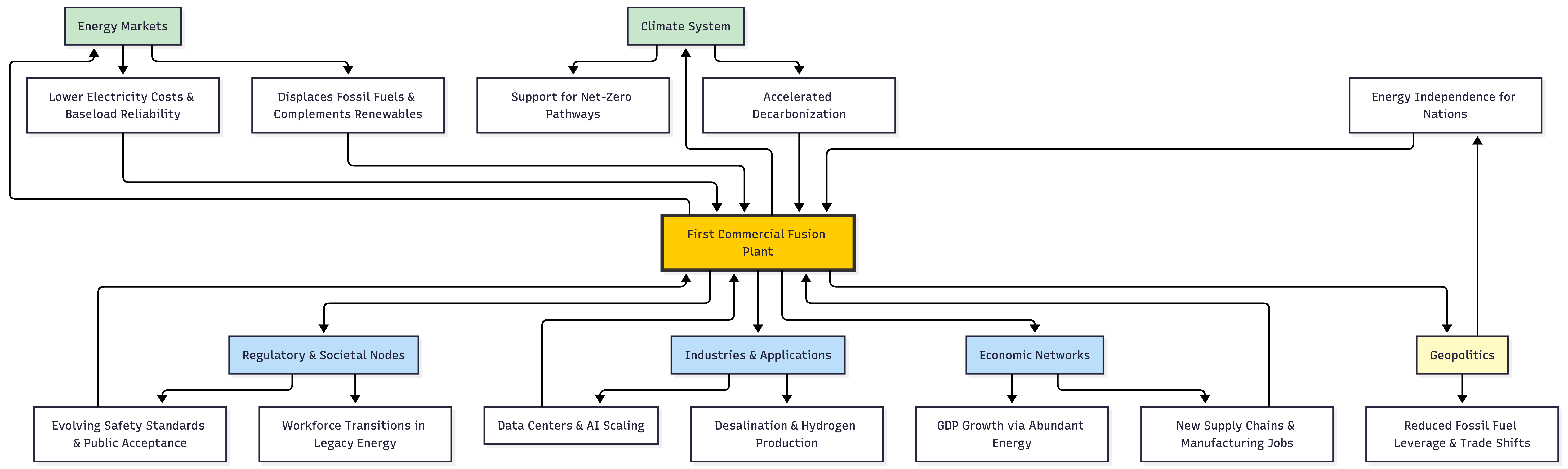
Industries such as computing, manufacturing, and transportation gain reliable power for scaling, while desalination and synthetic fuels open secondary markets. Regulatory and societal nodes evolve with updated safety standards and public acceptance, potentially easing fission expansion or inspiring further clean-tech investment. Challenges include workforce transitions in legacy energy sectors and initial high capital costs that require policy smoothing. Overall, the network illustrates fusion as a catalyst for systemic transformation, where initial deployment amplifies through feedback loops of innovation, investment, and adoption.
Conclusion
Commercial nuclear fusion efforts have reached an inflection point where scientific foundations meet engineering execution and market pull. Private innovation, bolstered by technological leaps and supportive conditions among countries and sectors, positions the field for tangible electricity delivery within the coming decade. While challenges in materials, fuel cycles, and economics demand continued attention, the momentum suggests fusion could deliver on its promise of clean, limitless power. The first successful plants will not merely add capacity but reshape global energy systems, economies, and environmental trajectories. Sustained investment and collaboration will determine how quickly and equitably these benefits spread.
Sources
Forbes article on fusion frontrunners (February 2026): https://www.forbes.com/sites/drewbernstein/2026/02/12/who-will-be-first-to-unlock-nuclear-fusion/
Undark on fusion startups (February 2025): https://undark.org/2025/02/11/startups-fusion-energy/
Fusion Industry Association news compilation (2026): https://www.fusionindustryassociation.org/news/fusion-in-the-news/
Wikipedia list of nuclear fusion companies: https://en.wikipedia.org/wiki/List_of_nuclear_fusion_companies
IDTechEx on fusion commercialization (April 2025): https://www.idtechex.com/en/research-article/fusion-energy-no-longer-30-years-away/33122
World Nuclear Association on fusion power: https://world-nuclear.org/information-library/current-and-future-generation/nuclear-fusion-power
Congressional Research Service report on commercial fusion (February 2026): https://www.everycrsreport.com/reports/R48866.html
ITER organization project roadmap: https://www.iter.org/project/road-iter
Commonwealth Fusion Systems official site updates: https://cfs.energy/
Helion Energy official site: https://www.helionenergy.com/
TAE Technologies official site and announcements: https://tae.com/
Scientific American on ITER milestones: https://www.scientificamerican.com/article/worlds-largest-nuclear-fusion-experiment-clears-milestone/
Clean Energy Platform on top fusion companies (December 2025): https://www.cleanenergy-platform.com/insight/top-5-fusion-companies-to-watch-in-2026
---
**About the Author**
Jose Luis Chavez Calva is an independent international consultant and economist specialising in energy markets, network theory and innovation. He holds a PhD in Economics from the University of Essex and previously served in Mexico’s Secretariat of Finance and Public Credit (SHCP) and as General Coordinator of the Electricity Market at the Energy Regulatory Commission (CRE). He has been an independent advisor for the last 10 years and has more than 18 years of professional experience. He is a recipient of the 2011 National Public Finance Award.
All original ideas are not mine, but all wrong facts are entirely my own. This article is not investment advise.
Full archive of articles: joseluischavezcalva.substack.com