
The E-Ink Renaissance?
How Faster, Clearer Reflective Displays Are Reshaping Healthier Digital Habits, Sustained Productivity and Eco-Friendly Computing

Published 30-june-2026

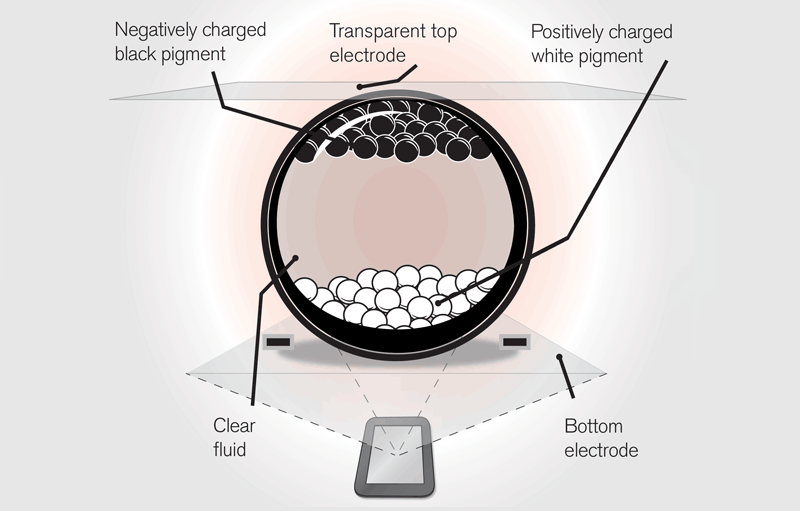
Electronic ink, often termed e-paper or e-ink, relies on microscopic charged particles suspended in fluid between electrodes. When voltage is applied, these particles migrate to create crisp, ink-like images that reflect ambient light much as printed paper does. Unlike emissive screens that constantly emit light, e-ink remains visible without power once an image forms, owing to its bistable nature. This fundamental difference is the base of its appeal in an era marked by widespread awareness of prolonged screen exposure, rising energy costs and a collective desire for more natural interfaces.
The current surge derives from several converging factors. Years of incremental gains in particle chemistry and driver electronics have converged with broader societal shifts: mounting reports of digital eye fatigue, corporate sustainability targets and the practical demands of hybrid work and AI-assisted tasks. Where earlier generations suited only static reading, today’s implementations support scrolling, typing and even limited video playback. The technology has moved from niche e-readers to versatile tools that address real human needs rather than merely replicating LCD behaviours.

Technological Progress and Innovations: From Sluggish Refresh to Responsive Interfaces
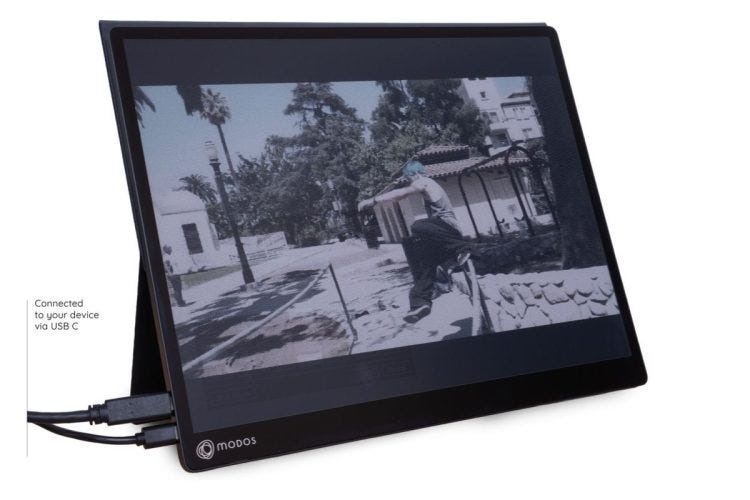
Development has accelerated markedly since 2024. Traditional electrophoretic panels refreshed at rates that made scrolling feel laboured, yet engineers discovered that the physical ink itself was not the primary bottleneck; rather, the waveform controllers and global refresh logic were. Wenting Zhang, working after hours, engineered a pixel-by-pixel driver that unlocked 60 frames per second on standard Carta panels. His open-source work, embodied in the Modos Flow 13.3-inch monitor, delivers 3200 × 2400 resolution at 300 pixels per inch, USB-C connectivity and programmable modes that trade contrast for speed or stability. Latency drops below 100 milliseconds in responsive modes, and ghosting is managed through selective clearing rather than full-screen flashes.

E Ink Holdings has meanwhile advanced its colour platforms. Kaleido 3 and Spectra 6 deliver print-like saturation with smoother waveform updates, while the Marquee outdoor variant supports animation at up to 12 frames per second and wide-temperature operation. Partnerships with MediaTek integrate AI SoCs that enable on-device summarisation, translation and optimised rendering for e-paper. Dasung’s Paperlike series has introduced 60-hertz portable monitors with front lights that adjust colour temperature, bridging the gap between e-readers and secondary displays. Experimental work reported in Nature demonstrates tunable colour metapixels capable of video rates above 25 hertz at extreme resolutions, hinting at future immersive applications.
These advances illustrate a shift from passive reflection to active, user-configurable performance without sacrificing core strengths.
Principal Actors, Market Tendencies and Current Technologies
E Ink Holdings maintains dominant supply of electrophoretic films, supplying Amazon, Kobo, Onyx Boox and signage manufacturers. Chinese innovators such as Dasung and BOE push portable monitors and large-format modules, while startups like Modos emphasise open hardware. Tendencies include hybrid colour systems, integration with AI accelerators and a pivot toward repairable, modular designs.
Current commercial offerings span personal tablets (Boox Note Air series running full Android for apps including ChatGPT), dedicated monitors (Dasung and Modos) and home appliances (SwitchBot weather stations or InkPoster frames that run for months on small batteries). Commercial deployments appear in electronic shelf labels that update wirelessly with negligible power, hospital patient boards that stay illuminated without disturbing sleep, and automotive surfaces that change appearance on demand.

Real-World Applications in Personal, Home and Commercial Contexts
Users report transformative experiences, one entrepreneur with partial vision now codes extensively on a Boox tablet, pairing the AI dictation app with a crisp monochrome display that eliminates the fatigue previously induced by hours on a MacBook. Scrolling through documentation, reviewing diffs and dictating changes all occur with minimal distraction and sustained comfort. At home, always-on e-ink dashboards display calendars, weather and family notes without adding to electricity bills or light pollution. In retail and transport, vast colour panels update pricing or timetables instantly while consuming fractions of the energy required by LED equivalents. Airports and hospitals install large-format signage that remains legible in bright conditions and requires no constant cooling.
These deployments demonstrate the technology’s versatility beyond reading: it supports focused creation, passive information display and dynamic commercial communication alike.
Documented Advantages for Vision, Energy Use, Wellbeing and Productivity
Reflective operation eliminates direct glare and flicker. Harvard School of Public Health research indicates that devices equipped with ComfortGaze front lighting impose up to three times less stress on retinal cells than comparable LCD panels, owing to reduced reactive oxygen species generation. Users experience fewer instances of dryness, headaches and disrupted sleep patterns. Energy consumption drops dramatically: a static image draws zero power, enabling weeks of use on modest batteries or solar harvesting in signage. Productivity benefits arise from extended comfortable sessions, reduced context switching on distraction-free interfaces and the ability to work outdoors or in varied lighting without performance loss.
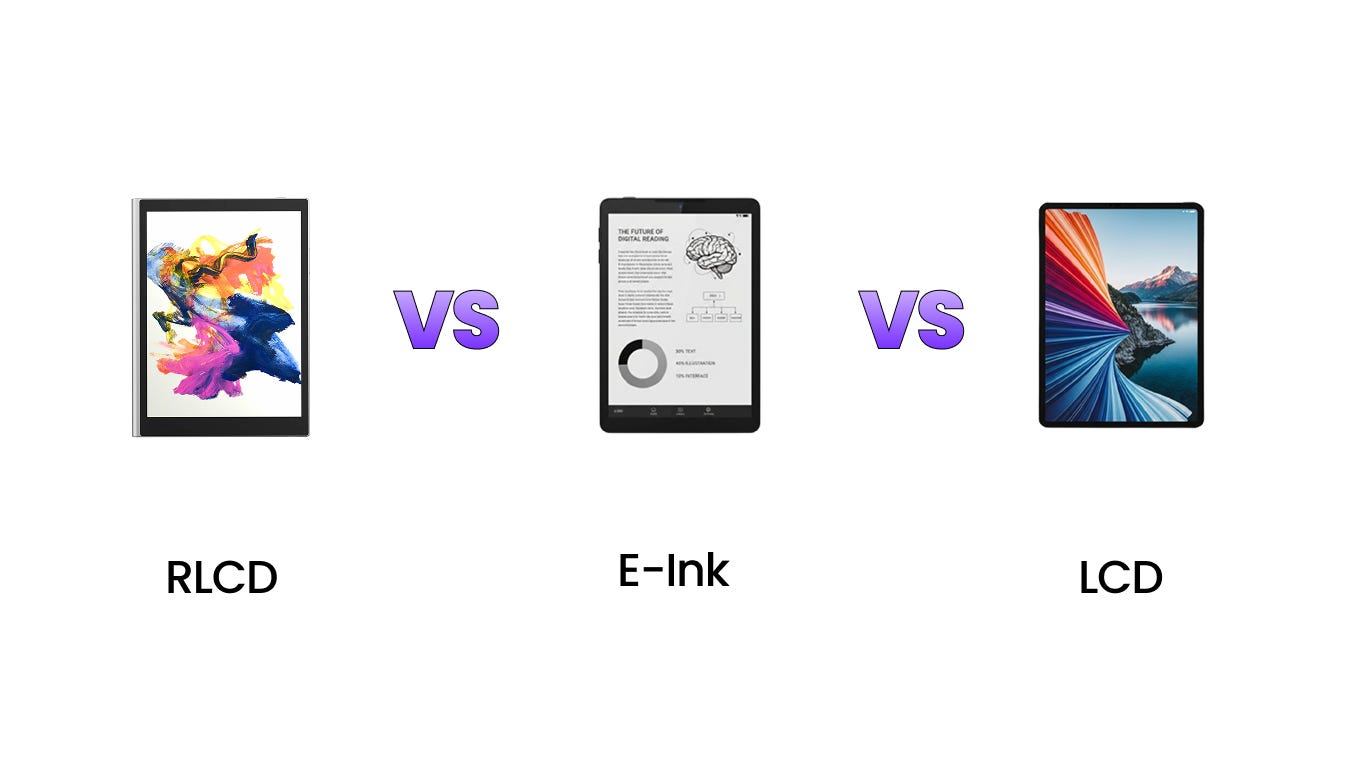
Commercial home products such as photo frames or planners reinforce daily utility without contributing to screen-time guilt. The combination of low power, natural readability and customisable warmth proves especially valuable for children, older adults and knowledge workers who spend long periods reviewing text.
Enduring Challenges in Adoption and Performance
Cost remains elevated for premium colour or high-refresh units. While ghosting has diminished through intelligent dithering and partial updates, certain fast-motion content still reveals limitations. Manufacturing scale-up for diverse panel sizes continues to constrain availability, and early adopters note that full-colour vibrancy trails self-emissive technologies in specific artistic or marketing contexts. Integration with legacy ecosystems requires careful driver support, and panel longevity under constant high-frequency use requires ongoing monitoring.
Market Conditions and Stakeholder Shifts Propelling Change
Heightened awareness of blue-light effects, corporate net-zero commitments and the energy demands of AI infrastructure have aligned incentives. Taiwan and China lead production capacity, fostering competition that drives down prices and spurs open-source alternatives. Retailers seek labour savings through electronic labels; educators value distraction-light tools; technology firms explore modular hardware that appeals to repair-conscious consumers. Regulatory emphasis on sustainability and light-pollution reduction further tilts the balance toward reflective solutions.
Network Analysis: Interconnected Effects of Wider Adoption of Faster, Clearer E-Ink
Increased deployment of responsive e-ink generates cascading consequences across sectors. Direct effects include improved ocular health in education and healthcare, measurable reductions in device energy draw within consumer electronics and retail, and elevated concentration levels among knowledge workers. These feed into higher-order outcomes: policy incentives for green displays, economic gains from prolonged hardware lifespans, shifts in design paradigms toward matte and modular products, and environmental benefits from diminished paper consumption and cooling requirements. Feedback loops emerge as healthier users demand more such tools, spurring further innovation that lowers barriers for additional industries.
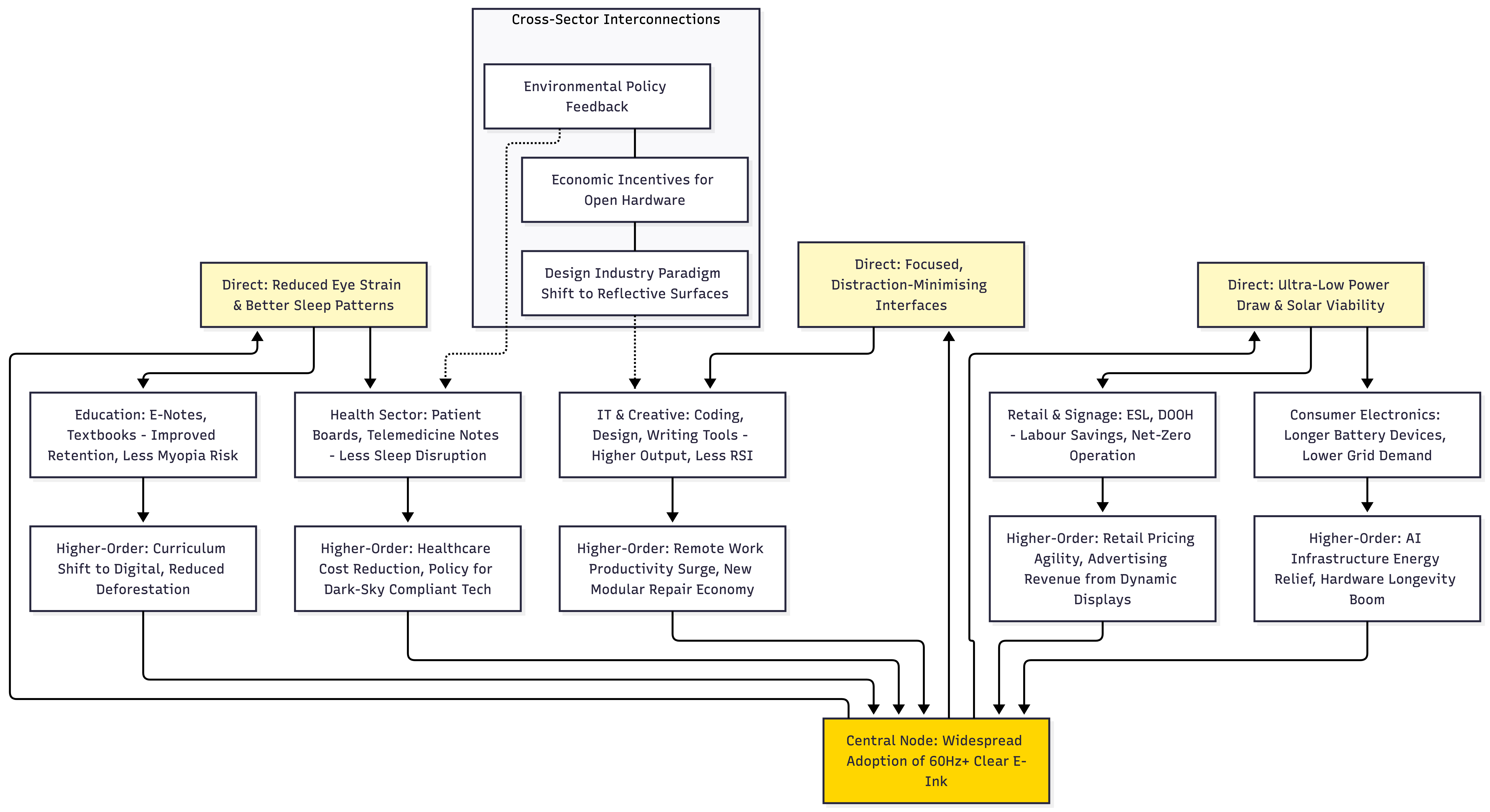
The graph reveals not isolated gains but an ecosystem where health improvements reinforce energy savings, which in turn enable broader commercial viability and cultural acceptance. Edge considerations include potential displacement of traditional display jobs offset by growth in repair and customisation services, and regional differences in adoption speed driven by electricity pricing and regulatory environments.
Horizons Ahead
Far from ephemeral, current implementations already deliver tangible daily value in homes, offices and public spaces. Future trajectories point toward hybrid devices that switch seamlessly between emissive and reflective modes, ultra-high-resolution colour suitable for professional graphics, and integration into architectural surfaces or wearables. AI could optimise rendering in real time, while open-source communities accelerate custom applications. The technology’s alignment with sustainability, human physiology and versatile computing positions it as a foundational element of next-generation interfaces.
Conclusion
The evolution of e-ink illustrates how seemingly incremental engineering advances can address profound human and planetary challenges. By combining paper-like comfort with responsive performance, these displays invite reconsideration of what productive, healthy interaction with digital content can entail. As adoption broadens, the cumulative effects promise quieter, clearer and more considered engagement with information across every domain of life.
Sources
Android Authority article on Modos Flow: https://www.androidauthority.com/modos-flow-e-ink-paper-60hz-display-3677057/
E Ink official site and news releases (2025-2026 announcements): https://www.eink.com/
Crowd Supply Modos Flow campaign details: https://www.crowdsupply.com/modos-tech/modos-flow/
X post by @antoine_os (ID 2065845034616864938):

X post by @daniel_nguyenx (ID 2071471863361094123):


Harvard-linked eye health studies referenced via E Ink publications: https://www.eink.com/upload/2025_04_28/51_20250428155204i9ls2kL8C5.pdf
IEEE Spectrum coverage of Modos and e-paper: https://spectrum.ieee.org/modos-e-paper-monitor
______
About the Author
Jose Luis Chavez Calva is an independent international consultant and economist specialising in energy markets, technology, network theory and innovation. He holds a PhD in Economics from the University of Essex and previously served in Mexico’s Ministry of Finance (SHCP) and as Head of the Electricity Market at the Energy Regulatory Commission (CRE). He has been an independent advisor for the last 10 years and has more than 18 years of professional experience. He is a recipient of Scholarship Awards for Graduate Studies from the National Council of Humanities, Sciences, and Technologies of Mexico and also of the 2011 National Public Finance Award of the Mexican Congress of the Union.
All original ideas are not his, but all wrong facts are entirely his own. This article is not investment advise.
Full archive of articles: joseluischavezcalva.substack.com