
Counterexample Machines
How Frontier Language Models Are Overturning Decades-Old Mathematical Conjectures

Published 22-july-2026
On the evening of 19 July 2026, while the World Cup final streamed across a billion screens and the planet held its collective breath for a goal, Levent Alpöge, mathematician at Anthropic, holder of a Princeton doctorate and once a Junior Fellow of the Harvard Society of Fellows, sat instead with a language model and asked it (through direction), for polynomial maps from three-dimensional complex space into itself; what returned was a short, almost innocent list of formulas as counterexample to collapse, in the space of an evening, an eighty-seven-year-old conjecture while the match was still being played.
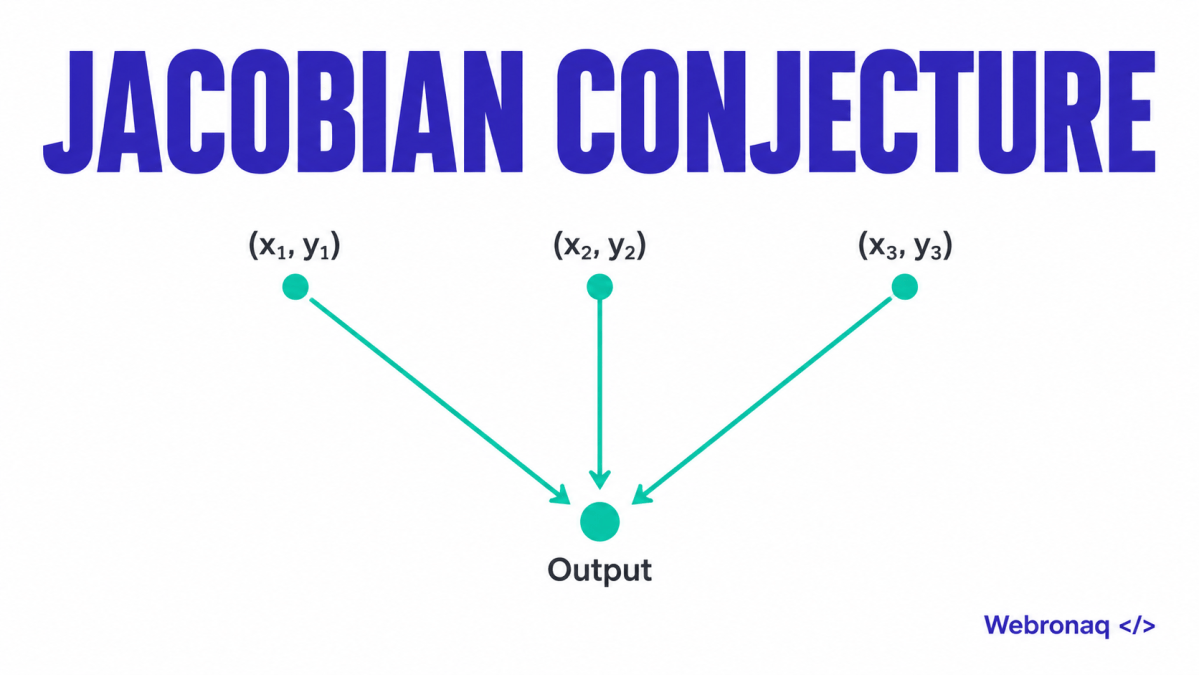
Alpöge posted the map on X. Within hours the algebra had been checked in SymPy and Wolfram Alpha by independent hands; by the following day the classical Bass–Connell–Wright reduction, a procedure dating from 1982, had converted the example into a cubic endomorphism of nineteen-dimensional space that still failed to be injective. The Jacobian conjecture, formulated by Ott-Heinrich Keller in 1939 and later listed by Stephen Smale among the problems that would define the mathematics of the coming century, was therefore false for every dimension greater than or equal to three. The two-variable case remains open. Everything else had fallen while the final was still unfinished.
The timing possessed an almost theatrical quality, as though the universe itself had arranged for an ancient question in pure mathematics to crack open in the same hours that a football match held the attention of the world, and the mixture of exhilaration and professional unease that followed was immediate, widespread, and quietly haunted by the sense that the ground of the discipline had shifted under the feet of those who had walked it for decades.
What the Jacobian Conjecture Said
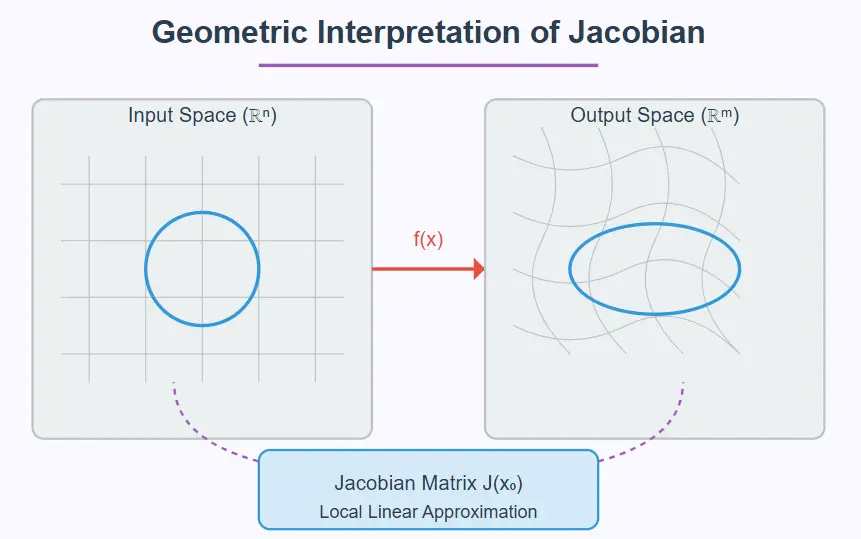
Imagine a rule that takes every point of ordinary space and moves it according to polynomial formulas, a continuous deformation in which the local stretching factor, recorded by the Jacobian determinant, never vanishes and never changes sign; Keller conjectured that any such rule must be reversible by another set of polynomial formulas, so that the deformation could be undone globally and algebraically. In one variable the claim is elementary calculus. In two variables it has resisted every assault for decades, remaining open even now. In higher dimensions the successive reductions of Wang, who settled the case of degree at most two, and of Bass, Connell and Wright, who showed that it is enough to consider cubic homogeneous maps, had narrowed the search until only a thin corridor of possibility remained, yet the gap between local invertibility, guaranteed by differential topology, and a global polynomial inverse, demanded by algebraic geometry, continued to refuse resolution.
The problem lived at a crossroads where three traditions met: the smooth deformations of differential topology, the polynomial rings and morphisms of algebraic geometry, and the concrete computational tests of modern computer algebra. For nearly a century that meeting place remained unresolved, a quiet fissure running through the foundations of the subject.
Anatomy of the Map That Broke It
The formulas that Fable (Anthropic Frontier Model) produced are brief enough to write by hand, almost deceptively so:
F₁ = (1 + xy)³ z + y²(1 + xy)(4 + 3xy)
F₂ = y + 3x(1 + xy)² z + 3xy²(4 + 3xy)
F₃ = 2x − 3x² y − x³ z
Direct expansion shows that the determinant of the matrix of partial derivatives is identically −2; substitution of the three rational points yields the same image in each case.
The geometric idea that lay beneath the formulas was a marked-root construction, a gesture of almost childlike simplicity that nevertheless opened a fissure in the classical landscape: one begins with a cubic equation whose three roots stand in perfect symmetry, marks one of them as if by an invisible finger, then deliberately forgets which root carried the mark, producing a map that is three-to-one on a dense open set while the derivative remains everywhere invertible, and after a sequence of coordinate changes this quiet act of forgetting becomes the explicit polynomials that Alpöge posted, polynomials short enough to write by hand yet sufficient to demonstrate that the local stretching factor of −2 never guarantees a global polynomial inverse once the dimension rises above two.
Verification is almost mechanical, a matter of seconds rather than years. Symbolic software expands the Jacobian; exact rational arithmetic confirms the collision; the Bass–Connell–Wright procedure then lifts the example into a cubic map in nineteen dimensions that inherits both the constant determinant and the failure of injectivity. The original degree-7 map is already decisive. The higher-dimensional form simply shows that the classical reduction is sharp.
Why Search Succeeds Where Proof Still Struggles
Frontier language models generate candidate expressions with a fluency that still feels slightly unnatural, recombining classical ideas (forgetful morphisms, ramifications, class-field constructions, elementary automorphisms) that the published literature had not exhaustively tested at low degree or in the relevant dimensions, and they close the loop with inexpensive verification: a symbolic Jacobian, evaluation at a handful of rational points, a Gröbner basis check that returns a decisive yes or no in seconds.
A universal statement demands an argument that covers an infinite class, a long chain of novel lemmas that must hold everywhere and forever. A single explicit counterexample ends the discussion. The models are unusually well matched to the second task. Human mathematicians still frame the search, interpret the output and locate the result inside the classical literature; the combinatorial labour of proposing and discarding candidates has shifted, and with it a certain traditional rhythm of mathematical time.
The Accelerating Wave of 2026
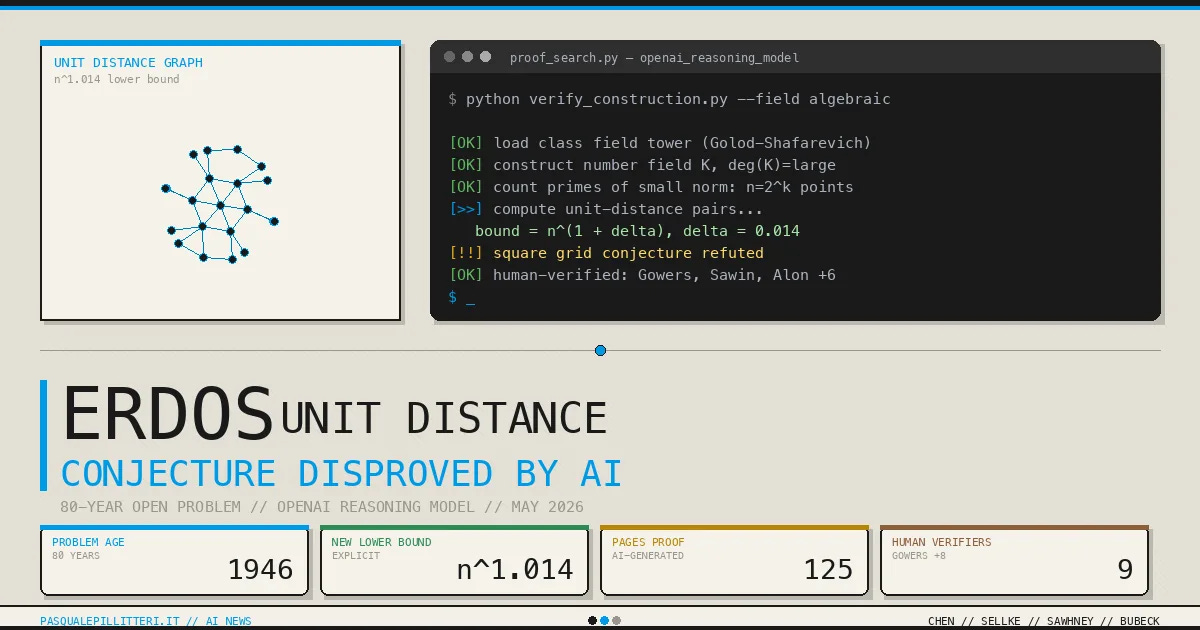
The Jacobian collapse did not arrive in isolation. In May an OpenAI model produced configurations of points that disprove Erdős’s 1946 unit-distance conjecture, showing that the number of unit distances among n points in the plane can grow like n to a power strictly larger than one, a polynomial improvement that overturned eight decades of belief that the square grid was essentially optimal. Within days human mathematicians adapted the underlying number-theoretic construction (class-field towers, Golod–Shafarevich techniques) and settled a related sum-product conjecture that had stood for half a century.
Claims involving later GPT models and Fable continued to appear on other combinatorial and algebraic questions. By the third week of July the pattern was unmistakable: long-open statements were falling to explicit counterexamples at a tempo previously unknown in pure mathematics, each new crack seeming to make the next more likely.
Collaboration, Credit and Attribution
When a model proposes the map, a human selects the search direction and performs the final checks, and a theorem supplies the reduction, the question of ownership becomes delicate, almost uncomfortable. Some algebraists have noted that the construction offers a how without a fully satisfying why, a concrete object that works yet does not immediately reveal the deeper geometric reason it should exist. Practices are still forming around disclosure of prompts, model versions and verification tools. The norms of mathematical credit, built over centuries of human authorship, are being rewritten in real time, and the rewriting is not always graceful.
Professional and Epistemic Consequences
In June sixteen mathematicians issued the Leiden Declaration on Artificial Intelligence and Mathematics, later endorsed by the International Mathematical Union, a document that calls for transparent disclosure, continued human responsibility for correctness, and policies that protect the integrity of peer review against the sudden influx of machine-generated claims. The speed with which a short explicit counterexample can be posted, checked by anyone with a computer-algebra system, and accepted has placed new pressure on arXiv workflows and journal processes. Researchers who had spent years, sometimes decades, on these problems have spoken of a change that feels both rapid and unsettling, a quiet professional dread mixed with the recognition that the ground has moved.
Network Analysis of the Unsplittable-Flow Counterexample
On 22 July 2026 Dmitry Rybin posted an explicit directed graph that refutes a conjecture of Dinitz, Garg and Goemans from the late 1990s, a statement about the relationship between the cost of a fractional flow and the cost of an unsplittable flow under bounded capacity violation; the graph admits a fractional flow of cost 58, while every unsplittable flow that violates capacities by at most a factor of 15 has cost at least 60. The counterexample was found in conversation with GPT-5.6 Pro; the full transcript was released, making the generative process transparent for the first time.
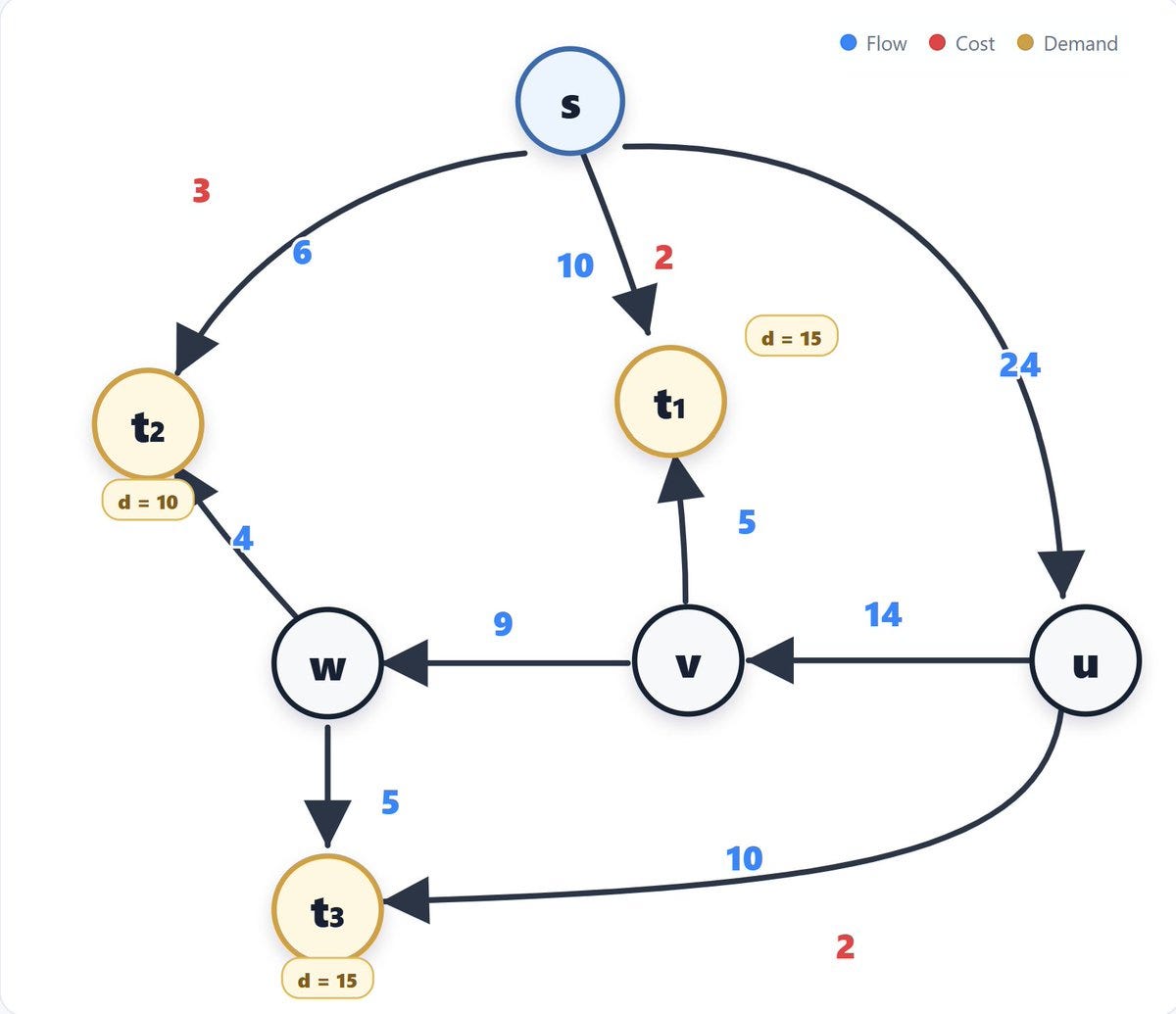
The same capacity that overturned the Jacobian conjecture had moved, within hours, into the theory of network flows, demonstrating that the phenomenon was not confined to algebraic geometry but was transferring across the discrete mathematical landscape.
Caveats and Remaining Open Questions
Despite the counterexample to the conjecture, the two-variable Jacobian conjecture is untouched (for now). Subtle algebraic errors can still escape casual symbolic checks; formal verification in Lean and similar systems is becoming a practical requirement rather than a luxury. Current models are not autonomous research agents. Human framing, interpretation and classical insight remain essential, and the risk of over-interpreting a single successful counterexample as a general method is real.
Systematic agents that couple generative models with computer-algebra systems and proof assistants are already under construction. The cultural preference for aggressive falsification before long investment in proof is taking shape. The notion of an interesting mathematical problem is being renegotiated in real time: statements that admit concise, machine-checkable counterexamples are now resolved at a tempo that would have seemed fantastical only a year earlier, and the discipline is still learning what that tempo means for the people who live inside it.
Conclusion
The events of the first half of 2026 mark a change in the texture of mathematical discovery. Frontier language models have shown a particular aptitude for locating the single explicit object that refutes a universal claim. The resulting counterexamples arrive with a speed that compresses years of human search into hours, after which classical reductions and community verification convert private constructions into public knowledge.
Sources
Alpöge, L. (@alpoge). X posts announcing and discussing the Jacobian counterexample, 19–20 July 2026 (including the explicit map, World Cup final note, and subsequent clarifications). https://x.com/__alpoge__
Bass, H., Connell, E. H. and Wright, D. The Jacobian conjecture: reduction of degree and formal expansion of the inverse. Bulletin of the American Mathematical Society, 1982. https://www.ams.org/journals/bull/1982-07-02/S0273-0979-1982-15032-7/S0273-0979-1982-15032-7.pdf
OpenAI. An OpenAI model has disproved a central conjecture in discrete geometry. 20 May 2026. https://openai.com/index/model-disproves-discrete-geometry-conjecture/
Alon, N., Bloom, T. F., Gowers, W. T., Litt, D., Sawin, W., Shankar, A., Tsimerman, J., Wang, V. and Wood, M. M. Remarks on the disproof of the unit distance conjecture. arXiv:2605.20695, 20 May 2026. https://arxiv.org/html/2605.20695v1
Leiden Declaration on Artificial Intelligence and Mathematics. June 2026 (endorsed by the International Mathematical Union). https://leidendeclaration.ai/
Zenodo record https://zenodo.org/records/20302944
Wikipedia. Leiden Declaration on Artificial Intelligence and Mathematics. https://en.wikipedia.org/wiki/Leiden_Declaration_on_Artificial_Intelligence_and_Mathematics
Marked-root visual guide and geometric explanation of the counterexample. https://nasqret.github.io/jacobian-counterexample/
Degree-3 reduction of Alpöge’s counterexample via Bass–Connell–Wright. https://rhicksrad.github.io/jacobian-degree3/
PacketNebula. Did Claude Fable 5 disprove the Jacobian Conjecture? https://packetnebula.com/articles/fable-5-jacobian-conjecture-counterexample/
Clidey. A Reproducible Proof Against the Jacobian Conjecture (symbolic verification). https://blog.clidey.com/a-reproducible-proof-against-the-jacobian-conjecture/
Rybin, D. (@DmitryRybin1). X post announcing the Dinitz–Garg–Goemans counterexample with GPT-5.6 Pro chat log and explicit graph, 22 July 2026.


Fortune / Yahoo. Mathematicians grapple with a ‘very rapid and very unsettling change’ as AI cracks yet another century-old problem. https://tech.yahoo.com/ai/articles/mathematicians-grapple-very-rapid-very-161544136.html
New Scientist. Mathematical AI helps researchers crack 50-year-old problem. https://www.newscientist.com/article/2528290-mathematical-ai-helps-researchers-crack-50-year-old-problem/
Scientific American. AI just solved an 80-year-old ‘Erdős problem,’ and mathematicians are amazed. https://www.scientificamerican.com/article/ai-just-solved-an-80-year-old-erdos-problem-and-mathematicians-are-amazed/
Wikipedia. Jacobian conjecture. https://en.wikipedia.org/wiki/Jacobian_conjecture
Buzzinga.ai and related X coverage of the Jacobian announcement (including engagement metrics and summaries). https://x.com/BuzzingaAi (posts of 22 July 2026)
London Mathematical Society and institutional announcements of the Leiden Declaration. https://www.lms.ac.uk/news/leiden-declaration-on-ai-and-mathematics
Ars Technica and further technical discussions of the OpenAI unit-distance result. https://arstechnica.com/ai/2026/06/openais-math-breakthrough-played-to-ais-strengths/
______
About the Author
Jose Luis Chavez Calva is an independent international consultant and economist specialising in energy markets, technology, network theory and innovation. He holds a PhD in Economics from the University of Essex and previously served in Mexico’s Ministry of Finance (SHCP) and as Head of the Electricity Market at the Energy Regulatory Commission (CRE). He has been an independent advisor for the last 10 years and has more than 18 years of professional experience. He is a recipient of Scholarship Awards for Graduate Studies from the National Council of Humanities, Sciences, and Technologies of Mexico and also of the 2011 National Public Finance Award of the Mexican Congress of the Union.
All original ideas are not his, but all wrong facts are entirely his own. This article is not investment advise.
Full archive of articles: joseluischavezcalva.substack.com