
Closing the Loop: Localisation and Self-Reinforcing Production in China’s Industrial Robotics

Published 28-july-2026

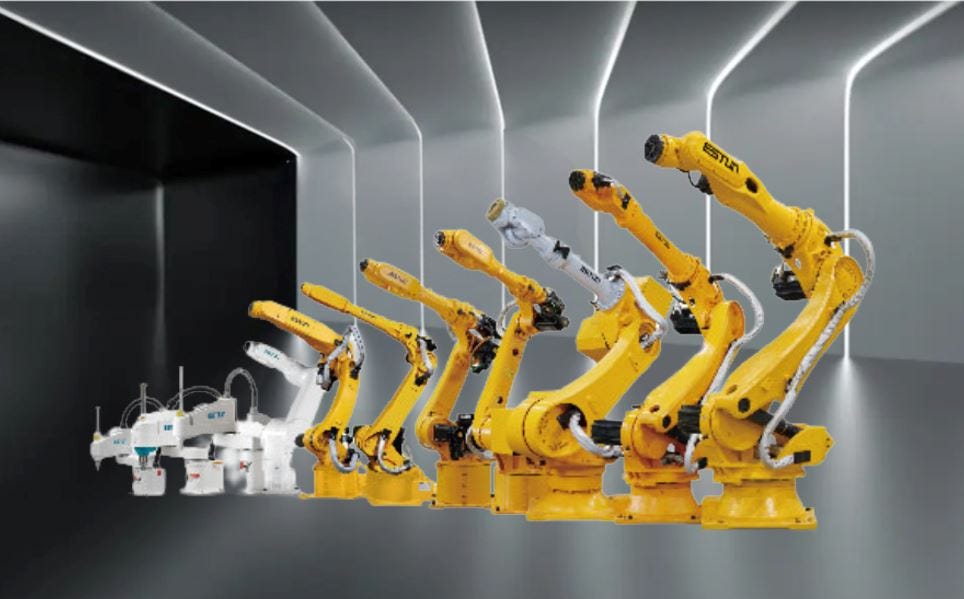
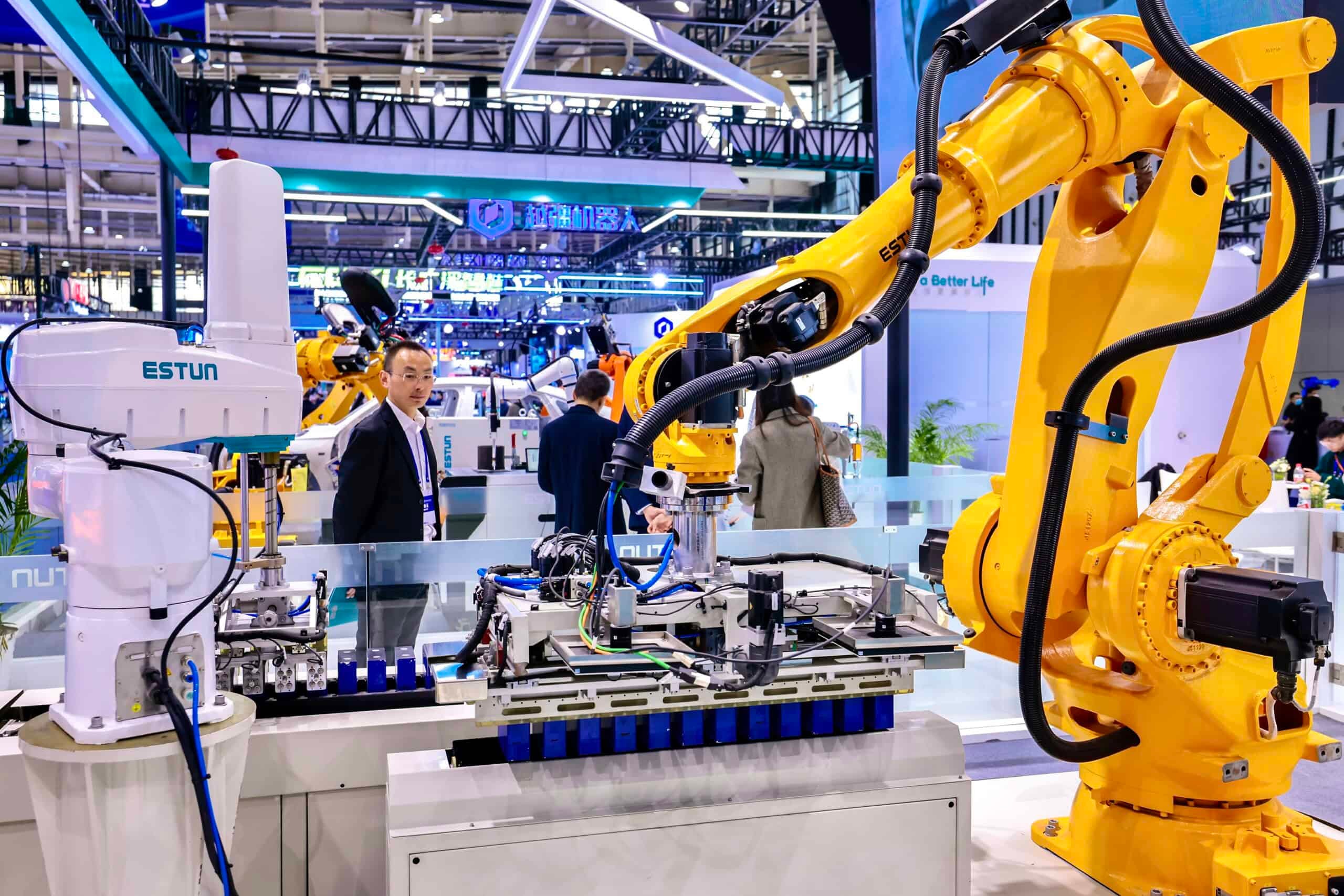
In a workshop in Chengdu, industrial robots leave the production line at a steady cadence of one every twelve minutes. The lines themselves run with high levels of automation. Embodied machines equipped with three-dimensional vision systems interpret complex, changing work environments, decide on actions, and execute them. Nearby, at facilities belonging to Estun Automation, heavy-payload six-axis arms rated at 1,200 kilograms undergo testing and assembly, their core components produced almost entirely within the same industrial ecosystem. These scenes, reported in Chinese media and highlighted in recent industry coverage, capture a structural shift underway in the world’s largest market for industrial robots.
China is moving from heavy reliance on imported machines and precision parts toward a more self-contained system in which domestic firms design, build, and deploy the robots that in turn produce more robots and the components they require. The process is incomplete, yet the direction is measurable in market shares, self-sufficiency rates, and the emergence of specialised suppliers.
Why the Shift Is Occurring Now
Several reinforcing forces explain the acceleration. China’s working-age population has peaked and is declining. Skilled trades, including welding, face persistent shortages while labour costs have risen. Manufacturers in automotive, electronics, electric vehicles, batteries and renewable-energy equipment require higher precision, longer uptime and greater flexibility than earlier generations of automation could reliably deliver at scale. Policy has reinforced the commercial incentives. Successive plans under the Made in China 2025 framework and subsequent industrial strategies assigned priority to robotics, set localisation targets, and channelled capital toward both system integrators and the precision-component specialists that feed them. Geopolitical tension and the experience of export controls on advanced equipment have further raised the value of domestic capability.
Technology has also matured. Advances in machine vision, real-time control software and sensor fusion allow robots to handle less structured tasks. The same capabilities that improve factory-floor performance also improve the production of the robots themselves, creating the conditions for the closed loops now visible in Chengdu and elsewhere.
Market Share Trajectory and the Estun Case
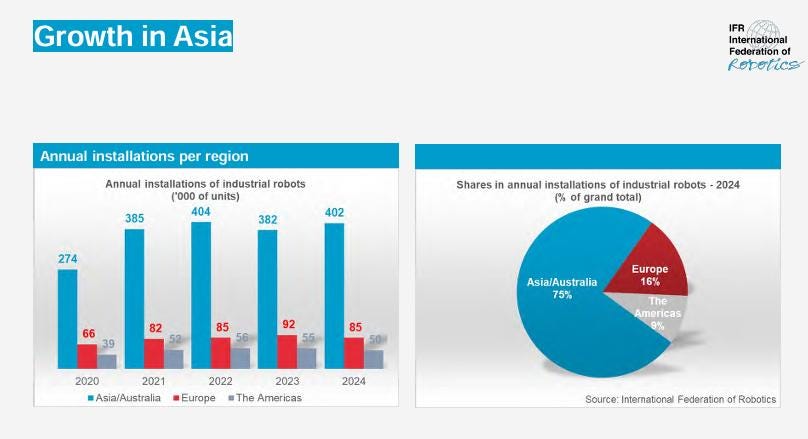
Domestic brands’ share of China’s industrial robot market rose from 31.4 percent in 2020 to 58.5 percent in 2024 according to official and industry data compiled by the China Machinery Industry Federation and consistent with International Federation of Robotics figures showing approximately 57 percent. Later reports and company disclosures place the figure higher still in 2025, with estimates around 60 percent and further gains expected. In absolute terms China installed a record 295,000 industrial robots in 2024, accounting for 54 percent of global deployments, and the operational stock surpassed two million units.
Estun Automation illustrates the corporate dimension of this shift. The company, which began in servo drives and motion controllers, has become the leading domestic supplier by shipment volume and, according to multiple 2025 reports, the overall market leader in China, overtaking long-dominant foreign names including Fanuc and ABB in the domestic market. Its market share in the first half of 2025 reached approximately 10.5 percent when including related brands. Estun reports more than 95 percent self-sufficiency in core components for its industrial robots, encompassing servo motors, drivers, controllers and mechanical structures. The ER1200, a 1,200-kilogram-payload six-axis arm, is described as the first fully localised heavy-payload model of its class to reach mass deployment. The company has also expanded into collaborative robots, recording strong shipment growth in early 2026, and has released a robot operating system, iER.OS, together with the Juliet programming language developed in collaboration with Cognibotics and designed for ROS-2 compatibility.
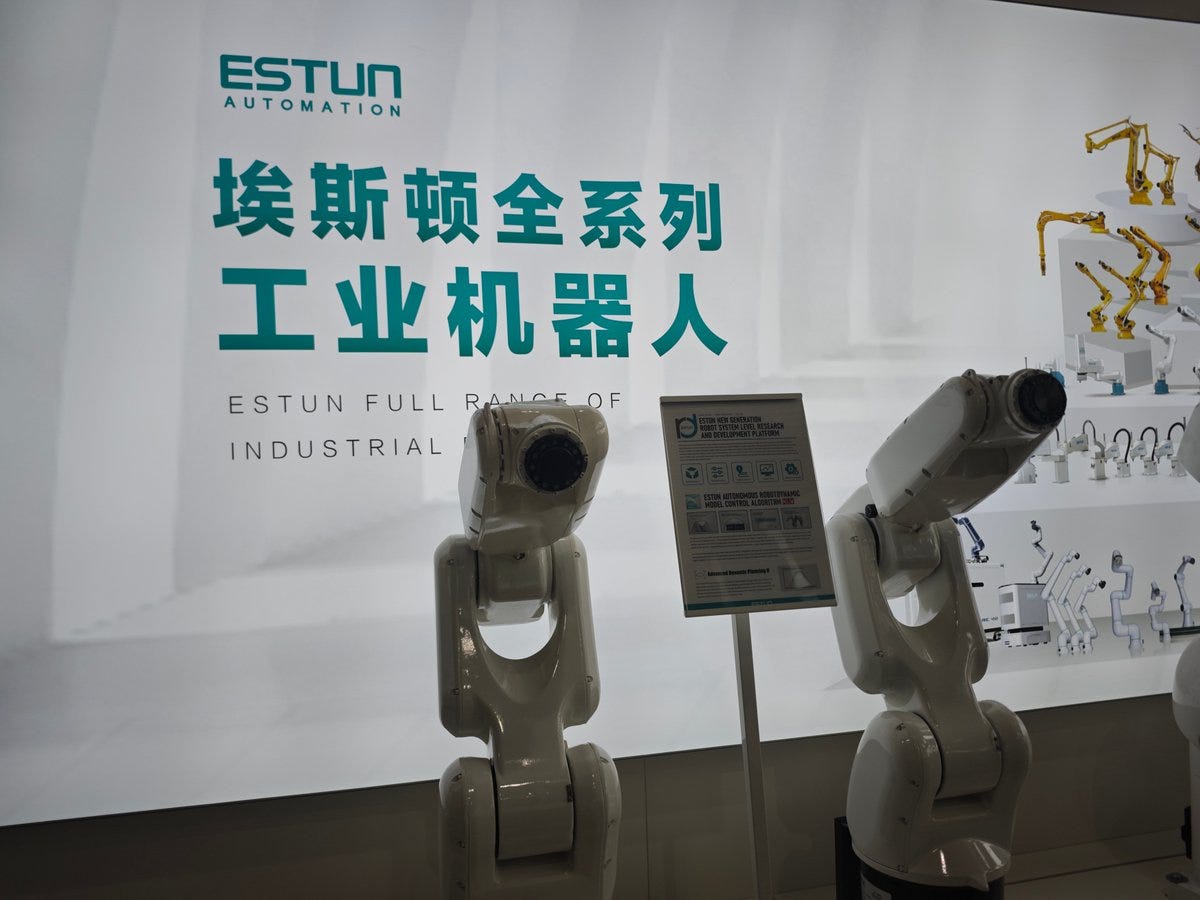
Vertical integration gives Estun control over iteration speed, cost structure and customisation. It also concentrates technical knowledge within a single organisation rather than across a chain of specialised foreign suppliers. R&D spending has remained near 10 percent of revenue for an extended period, supporting both incremental improvement of existing product lines and exploration of humanoid platforms.
Component Bottlenecks, Domestic Champions and the Localisation Drive
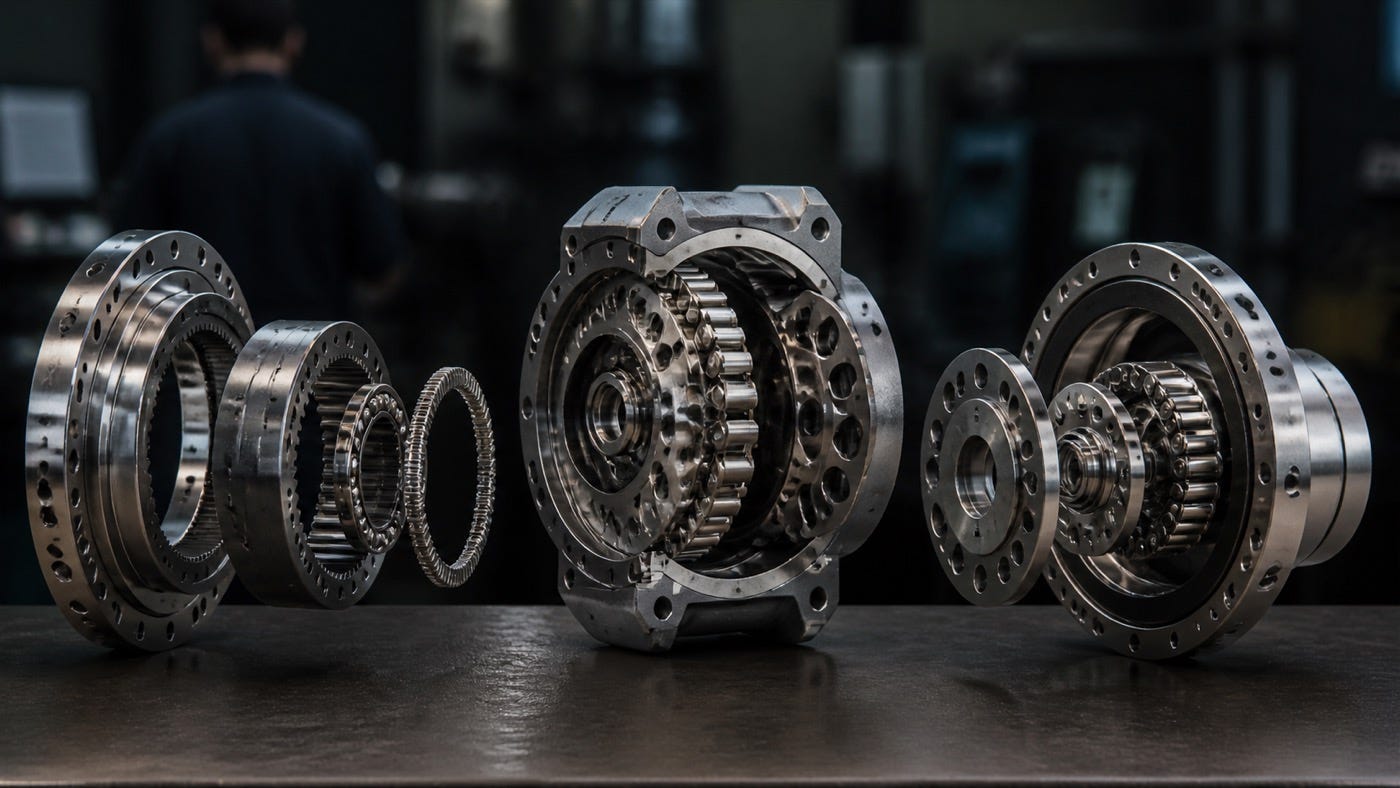
Precision reducers and high-performance servo motors remain the most demanding elements of the supply chain. RV reducers, critical for medium- and heavy-payload arms, still show domestic self-sufficiency in the range of 25–35 percent according to recent assessments, although some estimates for certain suppliers place the figure higher. Harmonic reducers, more common in lighter arms and collaborative robots, have advanced further, with domestic products accounting for more than 40 percent of units installed in Chinese-assembled robots. Humanoid-robot servo motors lag more substantially, with domestic ratios reported below 10 percent in some analyses. Industry and policy targets aim to lift overall core-component domestic ratios above 70 percent by 2028.
Specialised Chinese firms have emerged as champions. Leaderdrive, operating under the Green Harmonic brand, has become a leading global producer of harmonic reducers and a major supplier within China. Shuanghuan Transmission and related firms have expanded capacity in RV reducers. Inovance Technology holds a substantial position in servo systems and has developed highly automated production lines for these motors. Other firms supply end-effectors and intelligent grippers. Investment into these companies has been substantial, supported by both private capital and policy preference for domestic suppliers in public and strategic projects. The result is a gradual but visible substitution of Japanese and European precision components that previously occupied central positions in the supply chain.
Quality and longevity at the highest performance levels continue to improve yet still lag the most demanding applications in some segments. The gap is narrower in mid-range industrial use, where cost and delivery advantages of domestic supply are already decisive for many Chinese manufacturers.
End-Use Diffusion and Lighthouse Factories
Adoption is spreading beyond the traditional strongholds of automotive and electronics. AI-enabled welding systems address acute shortages of skilled welders by combining vision, seam recognition and autonomous path planning, reducing programming time for complex structures from hours to minutes. Collaborative-robot shipments have grown rapidly. In traditional industries the transformation is equally striking. Jiangsu Yueda’s cotton-spinning operations have been recognised by the World Economic Forum as the first lighthouse factory in the global cotton-textile sector. The facility deploys dozens of intelligent cameras, AGV fleets and automated material handling across hundreds of thousands of spindles and extensive loom capacity, delivering large annual volumes of yarn and fabric while improving productivity and reducing unit energy consumption.
These examples demonstrate that the same domestic robot and component base that serves high-tech manufacturing is now penetrating labour-intensive sectors that previously automated more slowly. The diffusion raises overall robot density and further expands the addressable market for Chinese suppliers.
Network Analysis of the Supply-Chain Rewiring
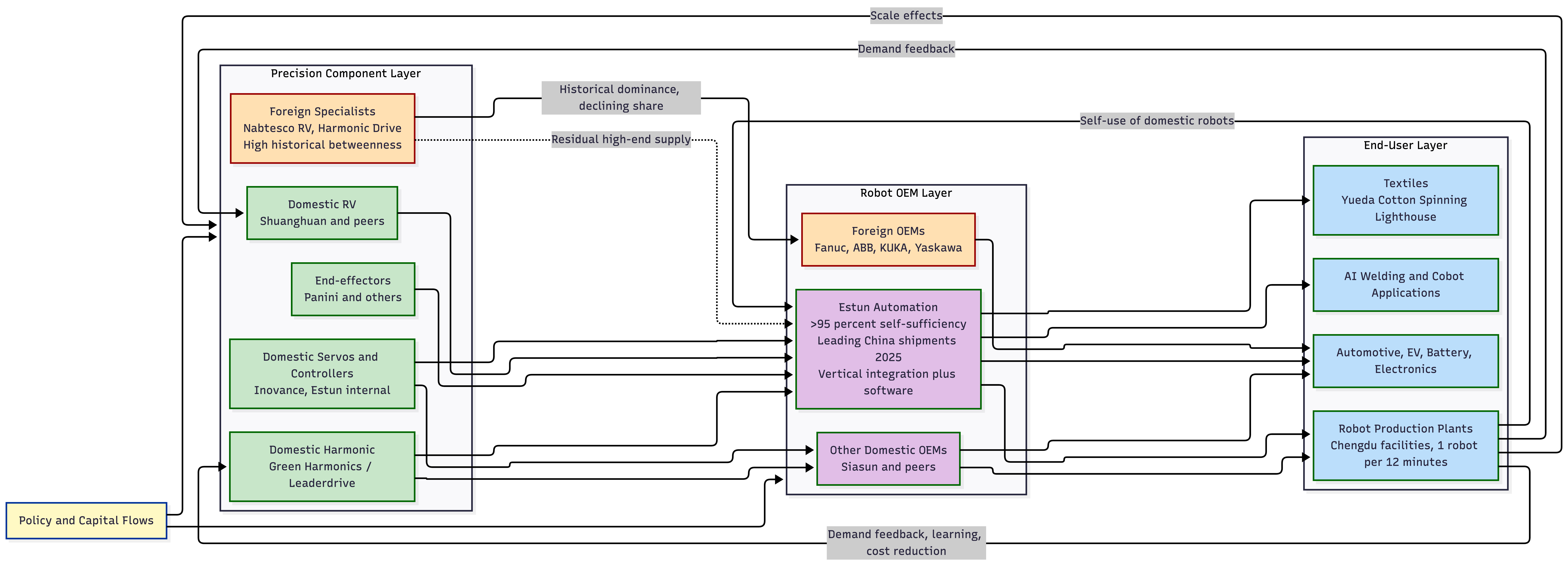
The industrial-robot ecosystem can be understood as a multi-layer network. One layer consists of precision-component suppliers. A second comprises robot original-equipment manufacturers and system integrators. A third contains the end-user plants that deploy the machines, including the factories that produce robots themselves. Edges represent supply contracts, technology flows, investment and policy support.
Historically the network was characterised by high betweenness centrality among a small number of foreign component specialists, particularly Japanese producers of RV and harmonic reducers and certain European and Japanese servo and controller makers. Chinese OEMs and end-users depended on these bridges. The current configuration shows a measurable densification of the domestic subgraph. Rising market shares for Chinese OEMs and improving self-sufficiency rates for key components increase the number and strength of edges that remain entirely within China. Estun’s vertical integration short-circuits several external links by bringing servo, controller and structural production inside the firm. Domestic specialists such as Leaderdrive, Shuanghuan-related entities and Inovance gain degree and centrality as orders and capital concentrate upon them.
Preferential attachment is visible: early successes attract further orders, talent and financing, accelerating scale advantages. Resilience improves because the removal of any single foreign node produces smaller cascade effects than in the earlier, more import-dependent topology. Most distinctive is the positive feedback, or autocatalytic, loop created when robot production plants themselves become heavy users of domestic robots and components. Higher domestic robot density increases demand for domestic reducers, servos and controllers; scale and learning improve cost and performance; lower costs and better availability raise adoption rates further, including in the robot factories that close the loop. The Chengdu facilities assembling a robot every twelve minutes embody this motif in physical form.
Secondary network processes reinforce the primary rewiring. Lighthouse-factory practices diffuse across industry networks, transferring organisational knowledge from early adopters in automotive and electronics into textiles and other sectors. The emerging software layer, including robot operating systems and higher-level programming languages, functions as a coordination network that can accelerate integration once critical mass is reached.
Drivers, Constraints and Competitive Responses
The structural drivers already noted (demographics, policy, demand from strategic sectors, and technological enablement) continue to operate. Learning-by-doing effects compound as domestic volume grows. Constraints remain real. Achieving consistent precision, durability and thermal performance at the extreme end of the specification range is still more difficult for some domestic reducers and servos than for the established foreign leaders. Software ecosystems and developer communities are expanding yet have not displaced the global open-source and proprietary standards that dominate advanced research and certain high-value applications. The distinction between rapid scale-driven catch-up and genuine frontier innovation remains visible in the highest-performance niches.
Incumbent foreign suppliers are responding in several ways: deeper localisation of their own manufacturing and sourcing inside China, concentration on the premium segments where performance differentials remain largest, and increased attention to export markets outside China where Chinese brands are beginning to compete more aggressively. Chinese industrial-robot exports themselves rose sharply in early 2026, indicating that the domestic capacity build is already generating outward pressure.
Outlook
A more localised and vertically integrated robot ecosystem reduces China’s exposure to component-level export controls and supply disruptions. It also intensifies competitive pressure on traditional Japanese and European suppliers within the Chinese market and, progressively, in third-country markets sensitive to price and delivery. The same component base, vision systems and software stacks that serve industrial arms are relevant to humanoid and general-purpose embodied systems, creating potential spillover. Over a longer horizon the question is whether the self-reinforcing production and learning loops now visible will generate cost and performance trajectories capable of altering global manufacturing economics and technology standards.
Toward 2028 the official localisation targets for core components remain ambitious. Progress to date suggests continued gains in domestic share and self-sufficiency are probable, particularly in mid-range applications and in the production of robots themselves. The highest-precision segments will advance more gradually. The network structure that has emerged, denser, more modular and partially closed-loop, is already distinct from the import-dependent configuration of a decade earlier.
Conclusion
China’s industrial-robot sector has moved from peripheral participant to the centre of both global demand and, increasingly, domestic supply. The combination of rising market share, vertical integration at leading firms such as Estun, the appearance of specialised component champions, and the physical reality of highly automated robot factories produces a system that is beginning to feed upon itself. Robots are building robots, and in doing so they are tightening the industrial and technological loops that determine cost, resilience and competitive position. The transformation is neither complete nor free of residual dependencies, yet the network dynamics already observable point to a durable shift in how one of the world’s most important manufacturing ecosystems organises its automation capabilities.
Sources
tphuang X thread, 26 July 2026:


CGTN, “A robot every 12 minutes? China’s smart manufacturing in action,” 27 July 2026: https://news.cgtn.com/news/2026-07-27/A-robot-every-12-minutes-China-s-smart-manufacturing-in-action-1P7DblQ2nxm/share_amp.html
Economic Daily / EDNewsChina coverage of Chengdu Carnup Robotics Technology Co., Ltd. production rates, July 2026: https://www.facebook.com/EDNewsChina/posts/at-chengdu-carnup-robotics-technology-co-ltd-in-chengdu-city-chinas-sichuan-prov/1376984564455794/ and related Instagram posts.
Tiger Brokers report on Chengdu Kanopu / Carnup robot assembly lines: https://www.itiger.com/news/1165859269
科技日报 feature on Estun, 12 June 2025: https://www.stdaily.com/web/gdxw/2025-06/12/content_353461.html
People’s Daily Online, “China’s robot industry doubles revenue in five years,” 5 December 2025: https://en.people.cn/n3/2025/1205/c90000-20398797.html
International Federation of Robotics, World Robotics 2025 report press materials: https://ifr.org/ifr-press-releases/news/global-robot-demand-in-factories-doubles-over-10-years
Estun Automation official reporting and H1 2025 market position: https://en.estun.com/?list_52%2F2288.html=
World Economic Forum Global Lighthouse Network press release, 15 January 2026: https://www.weforum.org/press/2026/01/global-lighthouse-network-recognizes-23-new-sites-launches-ai-platform-for-industrial-transformation/
WEF Yueda Textile case study details: https://initiatives.weforum.org/global-lighthouse-network/case-study-details/yueda-textile---yancheng---productivity/aJYTG00000018Mv4AI
Industry comparison citing CRIA and Interact Analysis on reducer market shares (domestic harmonic >35 percent, RV >30 percent by 2025): https://www.evsint.com/industrial-robot-reducers-harmonic-cycloidal-rv-comparison-2026/
Spherical Insights, China Industrial Robotics Market Insights and Future Outlook: https://www.sphericalinsights.com/our-insights/china-industrial-robotics-market
Straits Research, China Industrial Robots Market Size & Trends by 2034 (including October 2025 note that Estun Automation became the first domestic manufacturer to rank No. 1 in industrial robot shipment volume in China’s domestic market): https://straitsresearch.com/report/industrial-robots-market/china
Additional Estun Automation official disclosures on core-component self-sufficiency (>95 percent), vertical integration, product ranges and launches: https://en.estun.com/
______
About the Author
Jose Luis Chavez Calva is an independent international consultant and economist specialising in energy markets, technology, network theory and innovation. He holds a PhD in Economics from the University of Essex and previously served in Mexico’s Ministry of Finance (SHCP) and as Head of the Electricity Market at the Energy Regulatory Commission (CRE). He has been an independent advisor for the last 10 years and has more than 18 years of professional experience. He is a recipient of Scholarship Awards for Graduate Studies from the National Council of Humanities, Sciences, and Technologies of Mexico and also of the 2011 National Public Finance Award of the Mexican Congress of the Union.
All original ideas are not his, but all wrong facts are entirely his own. This article is not investment advise.
Full archive of articles: joseluischavezcalva.substack.com